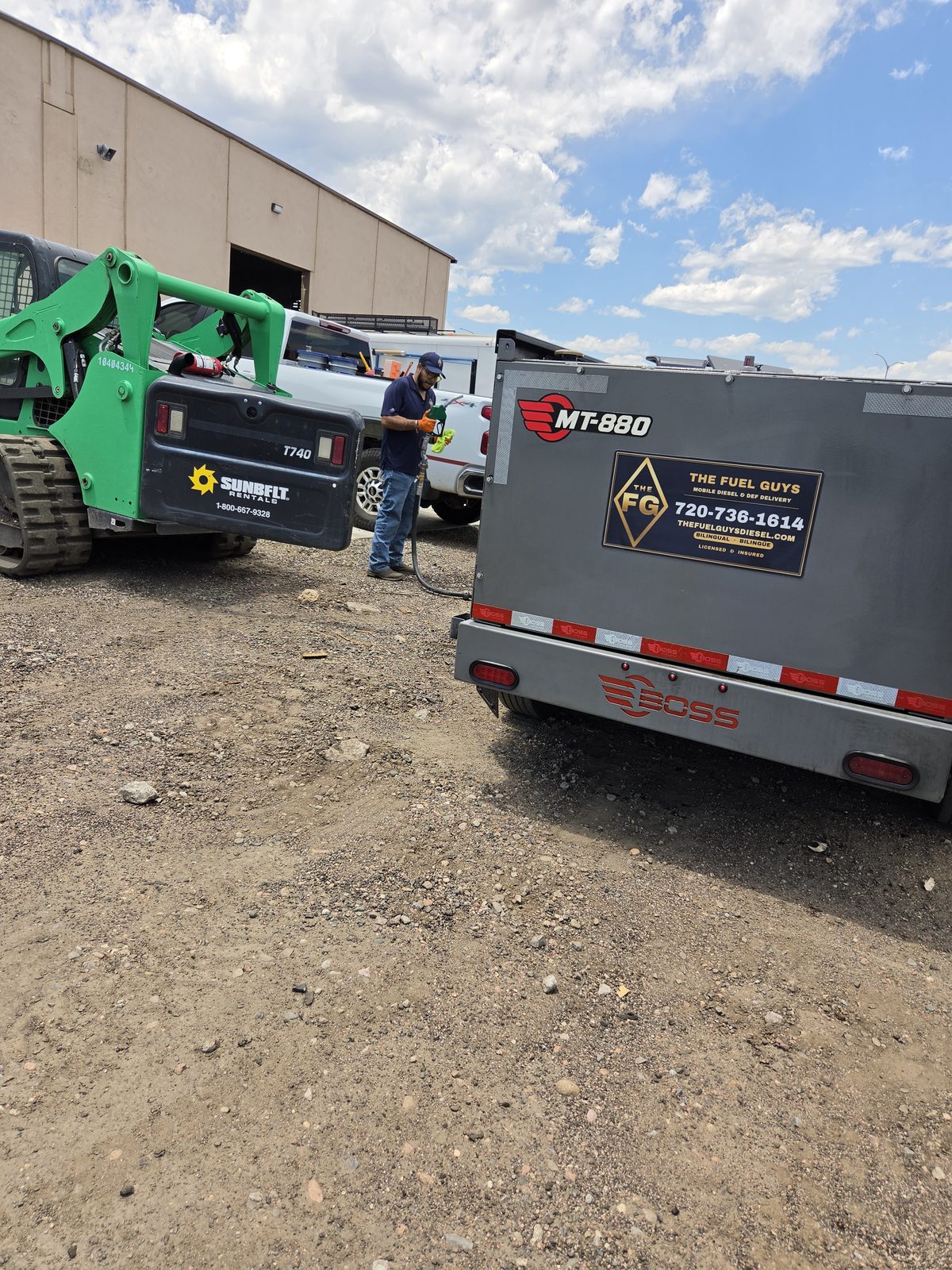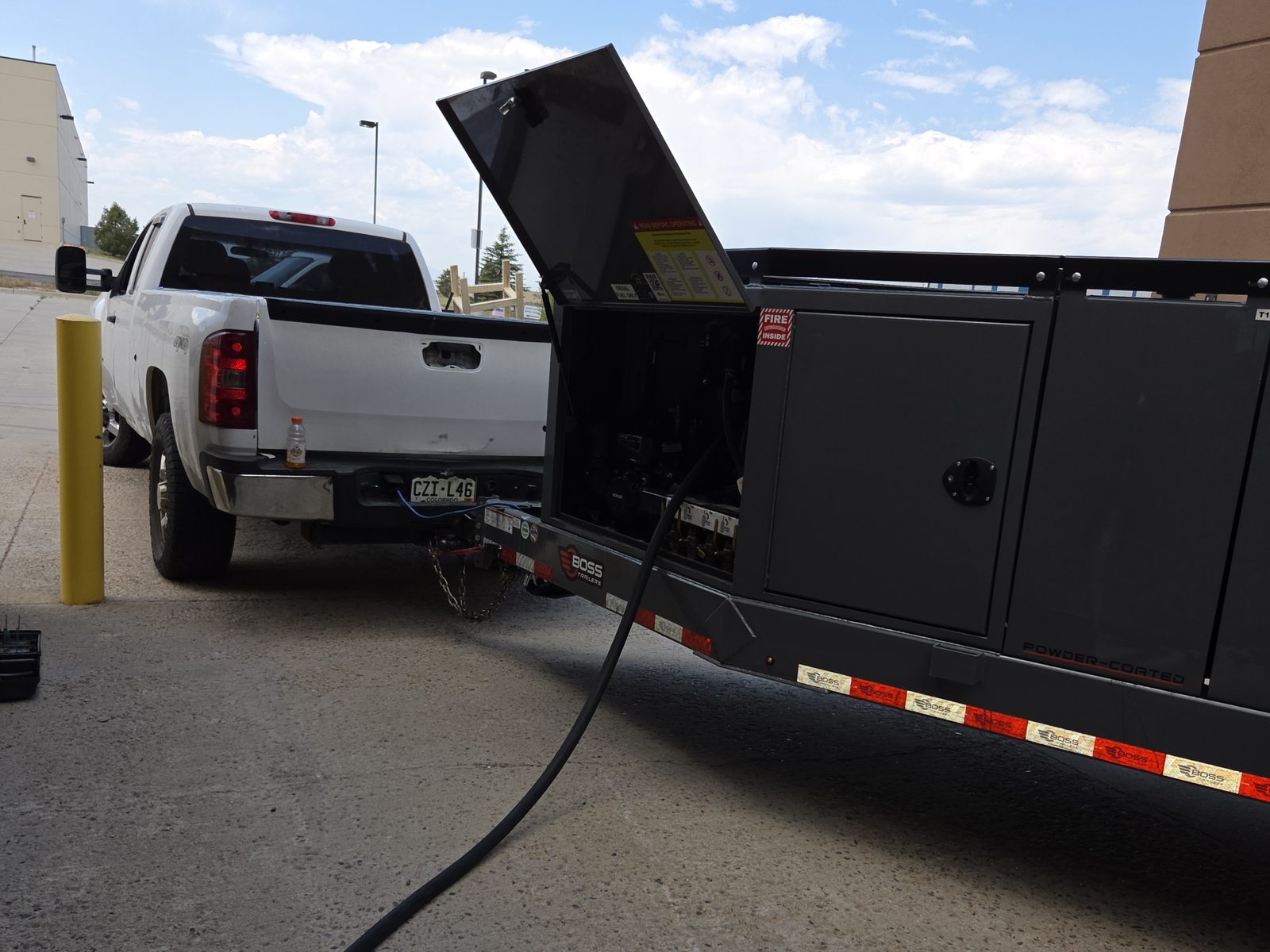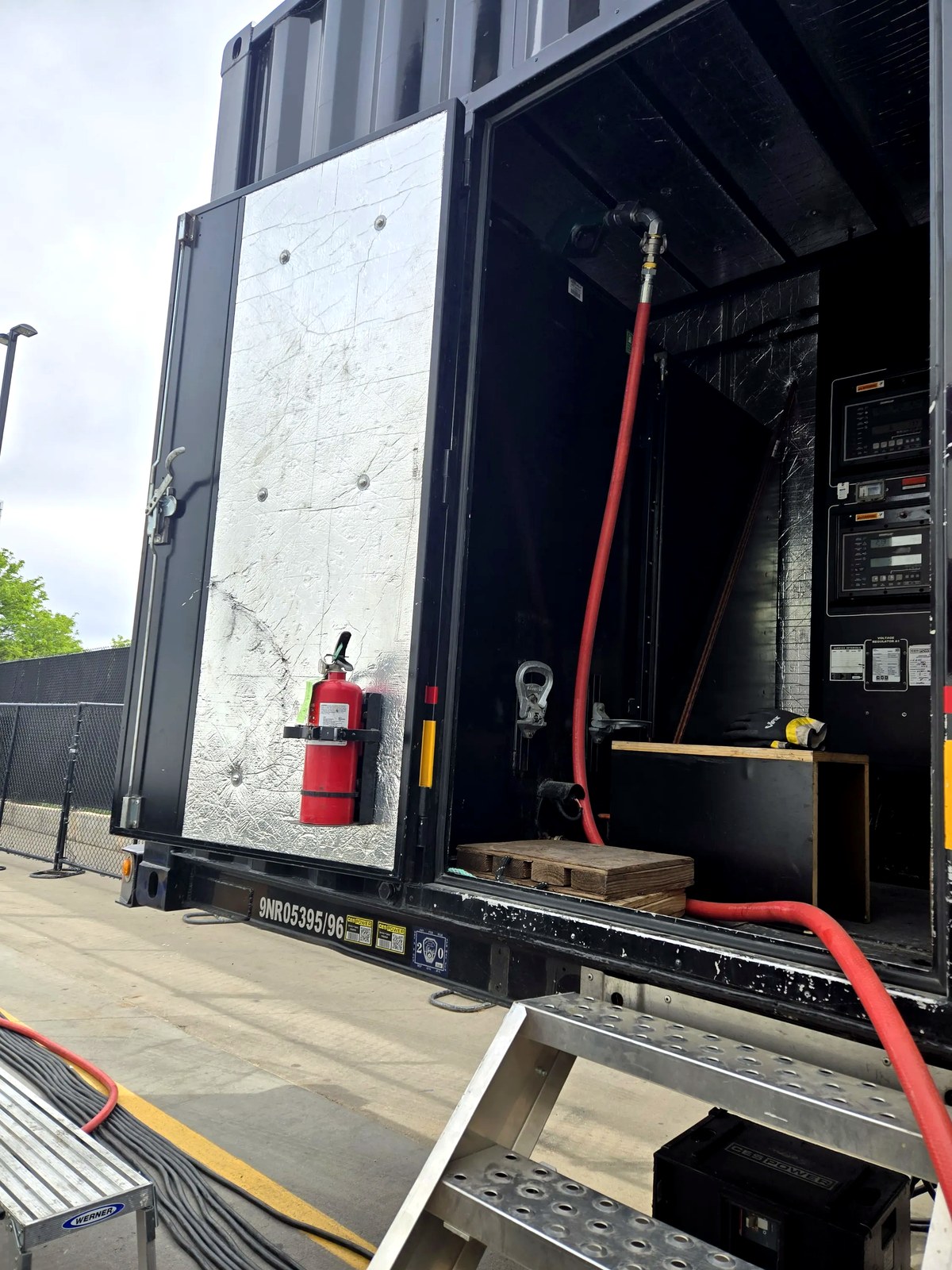
A generator that runs dry in a parking lot is an inconvenience. One that runs dry at 2 a.m. during a Front Range outage, while it is carrying a building's emergency loads, is a different animal. The lights go out a second time. The elevator stops wherever it is. And the machine that was supposed to fix the problem has become the problem — because a diesel engine that has pumped its tank to the bottom does not simply start back up when fuel shows up. That last part is what catches people, and it is worth understanding before you need it.
What happens in the first minute?
Fuel pressure falls off, the engine stumbles, and it shuts down. The transfer switch sees the emergency source fail and drops the load. Utility power is still out, so there is nothing to transfer back to. The building sits dark on whatever battery-backed lighting and UPS runtime it has, which is measured in minutes.
The panel usually logs this honestly — low fuel, then a shutdown. Cummins' operator manual for its DQF-series standby sets spells out what those warnings are supposed to buy you. A LOW FUEL alarm trips at roughly 62 percent of tank level. A CRITICAL LOW FUEL alarm means the level "has dropped to tank bottom," and the manual states the point of it plainly: to give "the operator time to shut down generator set before fuel runs out, preventing loss of prime or engine damage."
| Panel indication | What it means | What it is telling you to do |
|---|---|---|
| LOW FUEL | Level has dropped below the low-fuel setpoint (about 62% on the Cummins DQF sub-base tank) | Order fuel now, while the engine is still running normally |
| CRITICAL LOW FUEL | Level has dropped to tank bottom | Shut down on your terms before the engine takes air, or get fuel there within minutes |
| Low fuel shutdown / engine stopped | The engine has already lost its supply | Fuel plus a bleed-and-prime, and likely filters |
Read that middle row again. The critical alarm is not a countdown timer. It is the last point at which shutting the set down deliberately is cheaper than letting it run itself out.
Why won't it restart as soon as you add fuel?
Because it is full of air. Cummins' manual describes exactly this failure: continued operation at a critical low fuel level allows "air to enter the engine injection pump necessitating bleeding to restart the engine." Utah State University Extension's fact sheet on bleeding diesel fuel systems puts the mechanics plainly — when an engine runs out of fuel, air is trapped in the lines, and "when you try to start the engine this air acts as a lock, preventing the normal supply of fuel into the cylinder." Cranking harder does not clear it. It runs the batteries down and heats the starter.
The fix is a procedure, not a step. The general shape: shut the fuel valve, replace the filter elements, open the bleed plug on the filter nearest the tank, work the hand primer until fuel runs clean with no bubbles, then move outward through the system. If it still will not fire, crack the injection lines at the injectors, crank until fuel appears, and tighten them back down one at a time. The Extension sheet carries a caution worth repeating: "No attempt should be made to service the injection pump or nozzles. This requires special tools and know how."
Every engine is different — some newer electronic sets have priming pumps that do most of this for you, some older mechanical ones need the full manual sequence. The only correct procedure is the one in your engine's operator manual, and the time to find that manual is not during an outage. Print the fuel-system page and tape it inside the enclosure door.
What does the bottom of the tank do to your filters?
The last few inches of a storage tank are the worst fuel in the tank. Water settles out on the bottom, and sediment and microbial growth collect with it. NFPA 110 addresses this directly: Section 7.9.1.2 requires that "fuel system design shall provide for a supply of clean fuel to the prime mover," and Section 8.3.7 requires a fuel quality test at least annually using appropriate ASTM standards.
The practical consequence: an engine that ran itself to the bottom of the tank pulled that layer through its filters on the way down. So the restart is often not just a bleed — it is a bleed plus a fuel filter and water separator change, with a real chance the new filter plugs again once the tank is refilled and the sediment is stirred up. Add that to your time estimate.
What is the transfer switch doing while all this is going on?
Not what most people assume. The building does not light up the instant the lineman closes the recloser. The transfer switch runs a set of time delays first, and on a typical ASCO 7000-series controller the factory defaults look like this:
| Time delay | Default | What it is for |
|---|---|---|
| Normal failure (1C) | 1 second | Ignores momentary utility blips before calling for a start |
| Transfer to emergency (2B) | 0 | Lets the generator stabilize before it picks up load |
| Retransfer to normal (3A) | 30 minutes | Confirms utility is really back and stable before switching off the generator |
| Engine cooldown (2E) | 5 minutes | Unloaded run time after retransfer, before the engine is told to stop |
Look at that 30-minute retransfer delay. It means the generator is expected to carry the load for a good half hour after the lights come back on outside, plus five more minutes of cooldown. A facility manager who sees utility restored, decides "we made it," and stops watching the fuel gauge has miscounted by 35 minutes at the exact moment the tank is lowest.
What does refueling actually take on a live generator?
More coordination than a job-site fill. Four things decide whether this is a 30-minute stop or a three-hour problem, and all four are knowable in advance:
- Where the tank is. A sub-base tank at grade is straightforward. A set on a roof, in a below-grade vault, or behind a locked gate with a fire lane in front of it is not.
- Fill point and hose reach. Measure from where a truck can legally park to the fill. Do it on a sunny afternoon, not in the dark.
- Day tank or main tank. NFPA 110 Section 7.9.2 requires fuel tanks be close enough for the engine's fuel pump lift to work, "or a fuel transfer pump and day tank shall be provided." If your set runs off a day tank, that transfer pump needs power — and if the main tank is dry, filling the day tank is the only thing that helps.
- Who has keys and who signs. At 3 a.m. this is the most common delay on the list, and it costs nothing to fix now.
It is why we run 24/7 emergency delivery across the Denver metro rather than a phone tree. But a call the moment the alarm sounds still beats a call after the engine has taken air. One is a fuel delivery. The other is a fuel delivery plus a service call.
How do you keep it from happening at all?
Four things, in order of what they are worth:
- Know your run duration, not just your Class. NFPA 110 defines Class as the duration in hours the system must run at full rated output without refueling. Class 2 means two hours. A building can be fully code-compliant and be two hours from needing a fuel truck. Compliant is not the same as covered.
- Put a fuel call in the outage procedure, at the top. Not "if the outage goes long" — the first hour, every time. Fuel ordered and not needed costs you a topped-off tank. Fuel ordered late costs you a bled fuel system.
- Confirm the low-fuel alarm annunciates where a human actually is. A red light on a panel in a locked mechanical room at 2 a.m. is not an alarm.
- Order at a third of a tank. It leaves room for dispatch time, keeps the suction above the water and sediment on the bottom, and means nobody is bleeding a fuel system in the dark.
We deliver diesel and DEF to generators, job sites, and fleets across the Denver metro and Front Range, and we would rather be on your scheduled top-off list than in your outage. If you want to walk the fill point and set a trigger level before winter, that is worth doing now — request a quote and we will get it on the calendar.