Every Denver contractor running iron eventually asks the same question: do I put a fuel tank on this site, or have somebody come fill the machines? The answer is different on a three-month utility job than on a two-year highway package, and the gap is wider than most people assume once the tank stops being a tank and becomes a permit, a spill plan, and forty-five minutes of somebody's morning.
What does “wet hosing” actually mean?
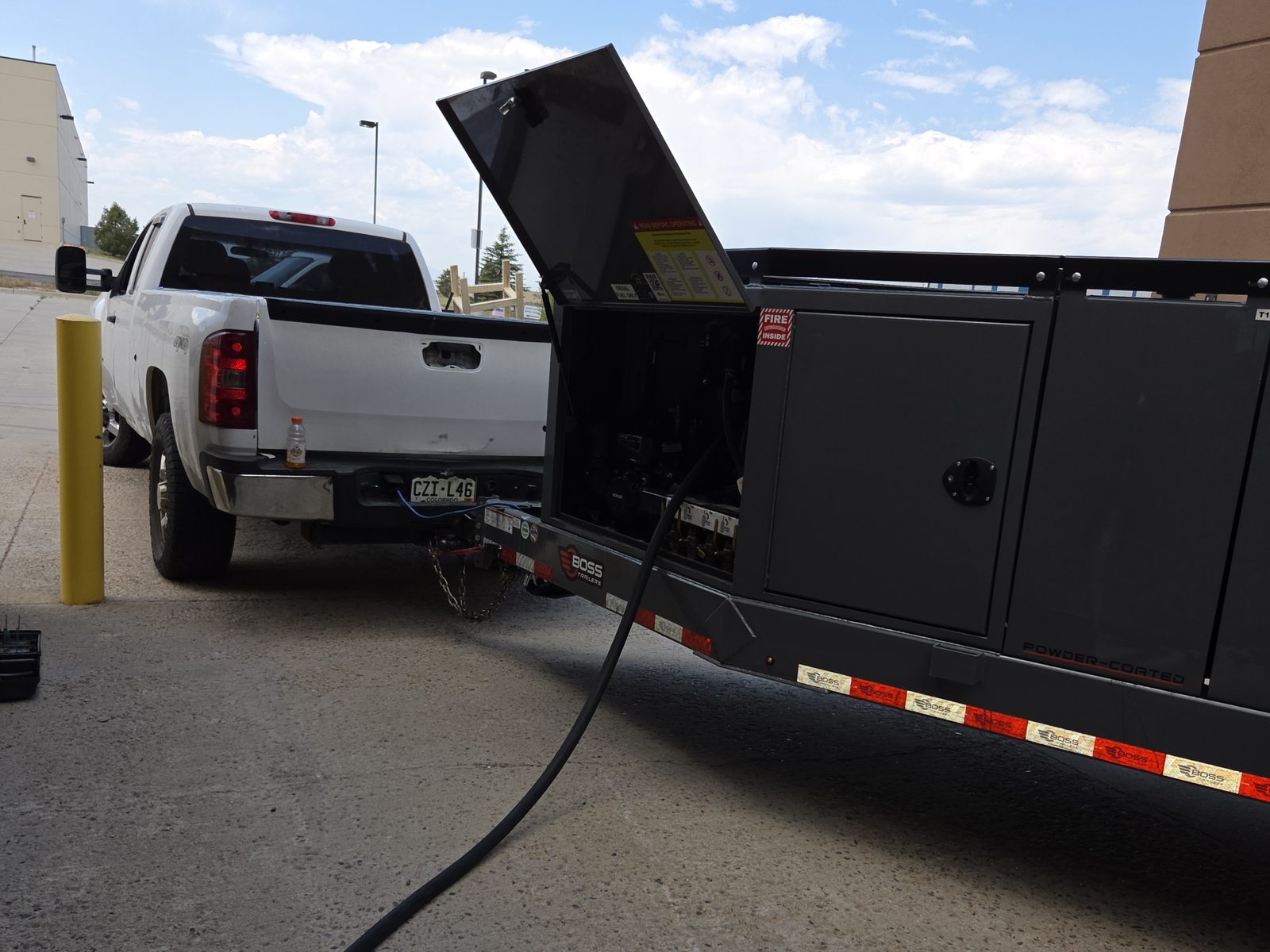
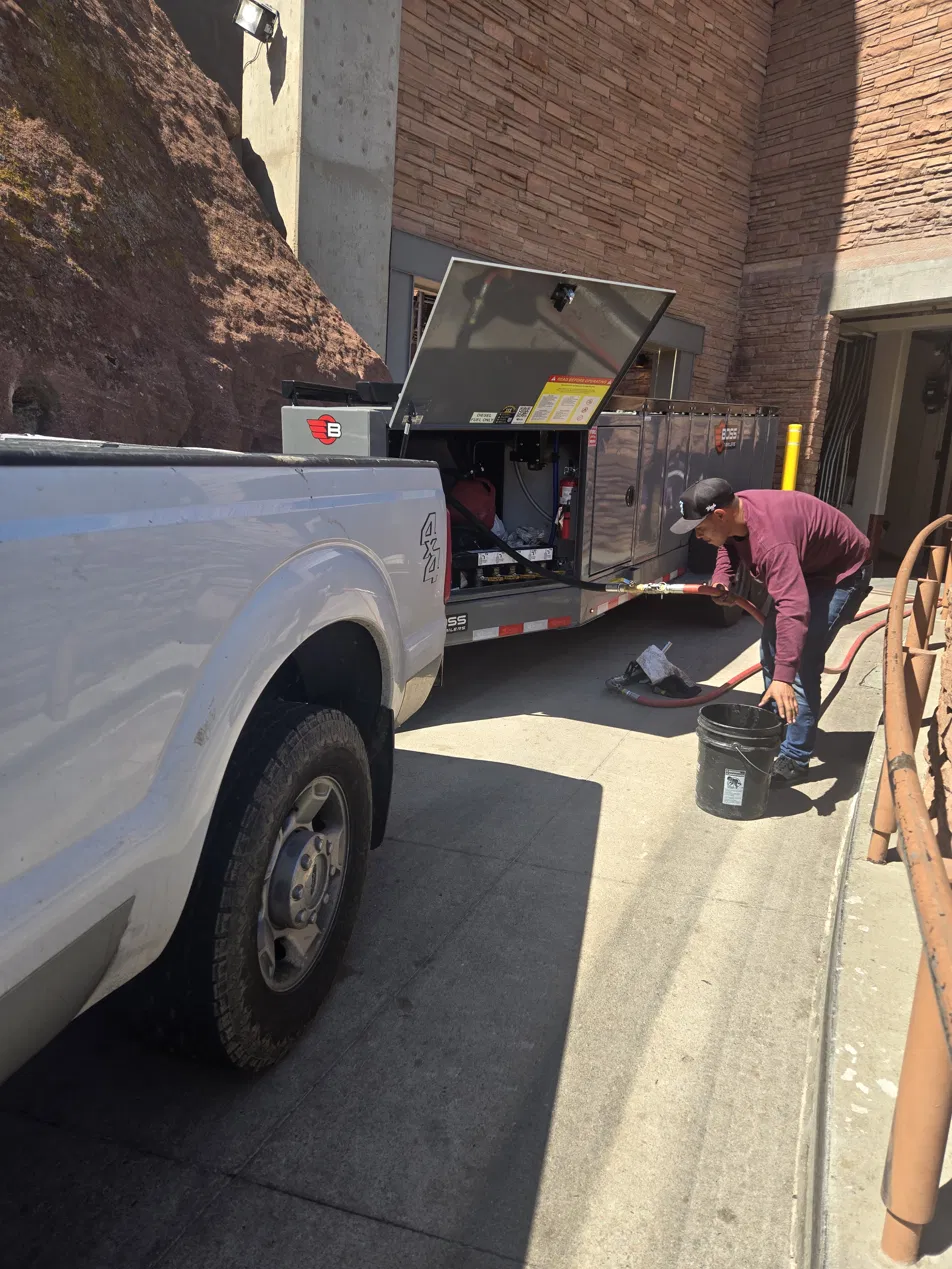
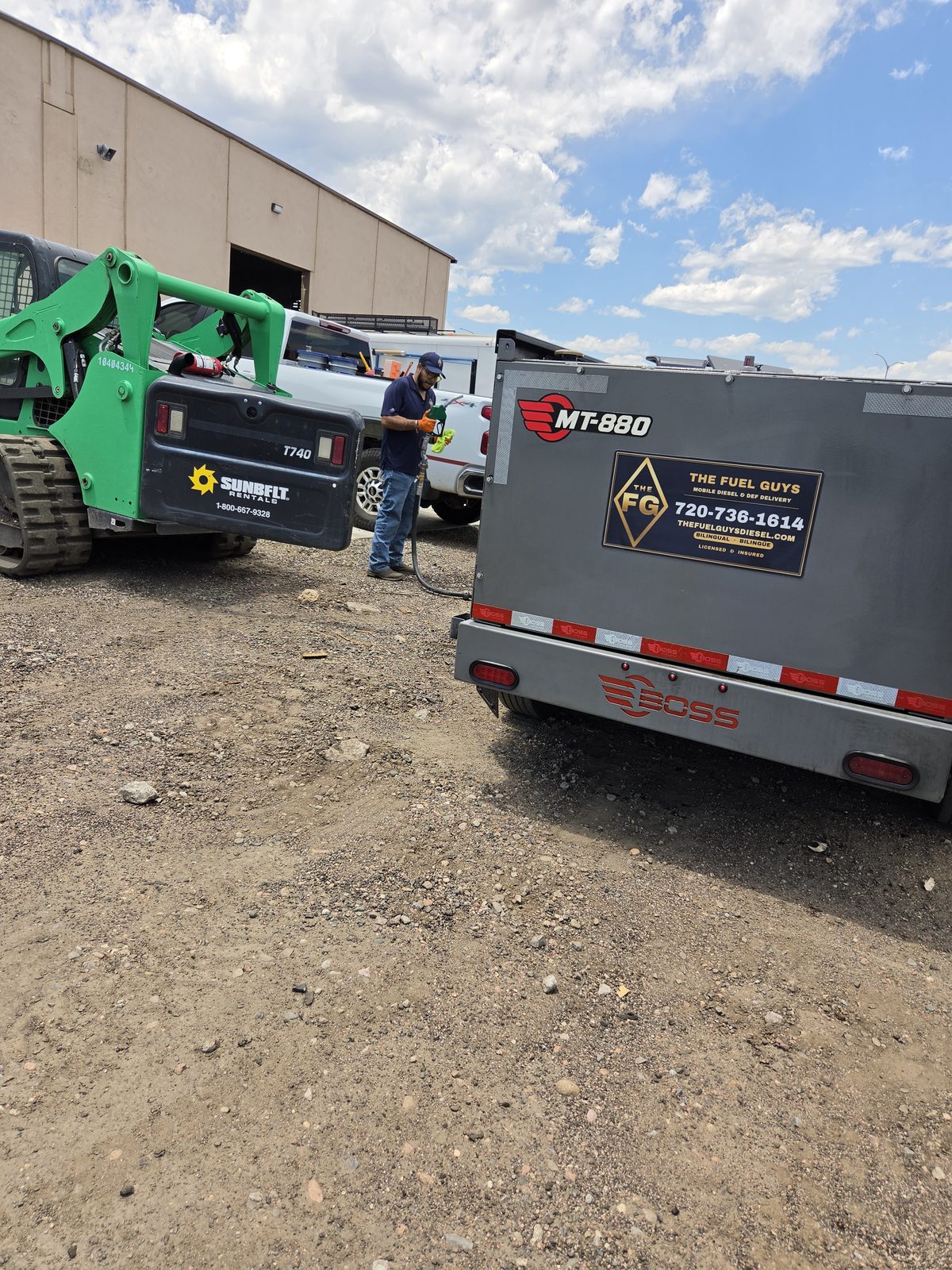
Wet hosing — also called wheel-to-wheel or direct-to-equipment fueling — is a fuel truck coming to your site and filling each machine from the hose. No storage tank. The driver works down the line, meters each fill, and leaves a ticket showing gallons by unit. Most of it happens after hours, so the excavators, dozers, generators, and light towers are topped off before the crew shows up.
Bulk delivery is the other model: a truck fills a tank you own or rent, and your crew fuels off that tank. Both are legitimate. They just move the cost, the labor, and the liability to different places.
Worth saying plainly, because tank makers and fuel haulers each argue their own book: a tank gives you fuel at 2 a.m. without calling anybody, and at high enough volume it buys cheaper gallons. Both are real advantages. The question is what they cost to get.
What does a job-site tank cost beyond the tank itself?
The tank is the cheap part. What follows it surprises people, because regulators count storage capacity, and the thresholds are lower than most contractors expect.
| Diesel stored on site | What it can trigger | Where that comes from |
|---|---|---|
| More than 60 gallons outside a building | A fire-code operational permit from your local authority | International Fire Code model permit language for Class II / Class IIIA liquids |
| 660 gallons or more in a single tank | Colorado's aboveground storage tank program | 7 CCR 1101-14, Colorado Division of Oil and Public Safety |
| More than 1,320 gallons aggregate | A federal SPCC spill plan | 40 CFR 112.1(d)(2)(ii) |
| More than 10,000 gallons aggregate | SPCC plan must be certified by a Professional Engineer, not self-certified | 40 CFR 112.3(g) |
Three details matter more than the numbers themselves.
The 1,320-gallon SPCC threshold is aggregate capacity, not contents. Containers under 55 gallons are excluded, but a 1,000-gallon job-site tank plus a 500-gallon skid puts you over even if both are half empty.
Colorado's aboveground tank rules do carry a construction carve-out, and it is worth reading before you rely on it. The regulation excludes tanks storing flammable and combustible liquids at “mining facilities and construction and earthmoving projects… where, in the opinion of the Director, tight control by the owner or contractor and isolation from other structures make it unnecessary to meet the requirements of this article.” That is discretionary, not automatic.
And the fire-code number moves the most. Denver-metro fire districts amend the International Fire Code differently from one another, and the same tank can be permitted in one jurisdiction and rejected in the next. Confirm the threshold with the authority having jurisdiction for your address before the tank arrives, not after.
Which one is actually cheaper?
Compare the whole line, not the price per gallon.
| Cost line | Wet hosing | Job-site tank |
|---|---|---|
| Fuel | Delivered price per gallon | Delivered price per gallon, usually lower at bulk volume |
| Delivery | Per-visit fee, or built into the gallon price | Per-fill fee, but fewer fills |
| The tank | None | Rent or purchase, plus freight in and freight out |
| Secondary containment | Carried on the delivery vehicle | Yours to provide and maintain |
| Permits and plans | Held by the fuel provider | Yours: fire permit, possibly an SPCC plan |
| Crew time | None — the driver does it | Someone fuels the machines every day |
| Measurement | Metered per machine on a ticket | Unattended volume, reconciled by stick or gauge |
| End of job | Nothing to remove | Pump-out, cleaning, and haul-off |
The line contractors underprice is crew time. In the Denver-Aurora-Centennial metro area, construction and extraction occupations averaged $31.64 an hour in May 2024, according to the Bureau of Labor Statistics. If one person spends forty-five minutes a day dragging a slip tank around and topping machines, that is roughly $24 a day in straight wages — about $475 over a twenty-day month, before burden, before the pickup's fuel, and before the production work that person was not doing. On a long job with a big fleet, bulk gallons can outrun that number. On a short job with six machines, they rarely do.
On fuel price itself: retail on-highway diesel in the Rocky Mountain region averaged $5.285 a gallon for the week ending August 3, 2026, per the U.S. Energy Information Administration. Treat that as directional only. Delivered bulk pricing and dyed off-road diesel both price differently, and the number moves weekly. Ask for the day's rate. Last reviewed August 2026.
When does a job-site tank win?
It wins on duration and volume. Eighteen months at one address with a fleet burning steadily every day, and a tank amortizes. It also wins when you need fuel at odd hours with no phone call: a remote site, night paving, a plant that cannot wait on a truck.
Tank suppliers make a fair point that wet hosing puts you on someone else's schedule, and a missed delivery is a dry machine at 6 a.m. That risk is real. It is also why you judge a fuel provider on dispatch and after-hours response, not on price alone. Ask what happens when a truck breaks down at 11 p.m., and get a straight answer before you sign.
Wet hosing wins when the job is short, the site is tight, the fleet is spread across several addresses, or you would rather not carry a permitted storage asset on your name. In infill Denver there is often nowhere secure to put a tank anyway.
What does the provider carry that you would otherwise carry?
This part never shows up on an invoice. Fire codes governing on-demand mobile fueling put the burden on the fueling operation, not the site. Washington's adoption of the model code, for example, requires the operator to hold a permit and approval from the fire code official, to attend the vehicle constantly during fueling with brakes set and warning lights running, to carry a 4A:80-B:C portable extinguisher, and to carry at least a five-gallon approved spill kit.
Colorado jurisdictions word it their own way, but the structure holds: the truck brings its compliance with it. Put a tank on your site and that compliance becomes yours, along with the inspection, the recordkeeping, and the phone call if something spills.
How should a Denver contractor decide?
Run it in this order. How long is the job? Under a year, wet hosing usually wins outright. What is the daily burn across the fleet, and is it steady or lumpy? Steady and large favors a tank. What does your authority having jurisdiction require at that capacity, and how long does the permit take? And who on your crew is actually going to fuel the machines?
If you want that comparison run against your real numbers, we will do it. Request a quote with your machine list and daily hours, or schedule a delivery and see what the ticket looks like. We deliver diesel and DEF across the Denver metro and Front Range and run 24/7 emergency service. See all our fuel delivery services.