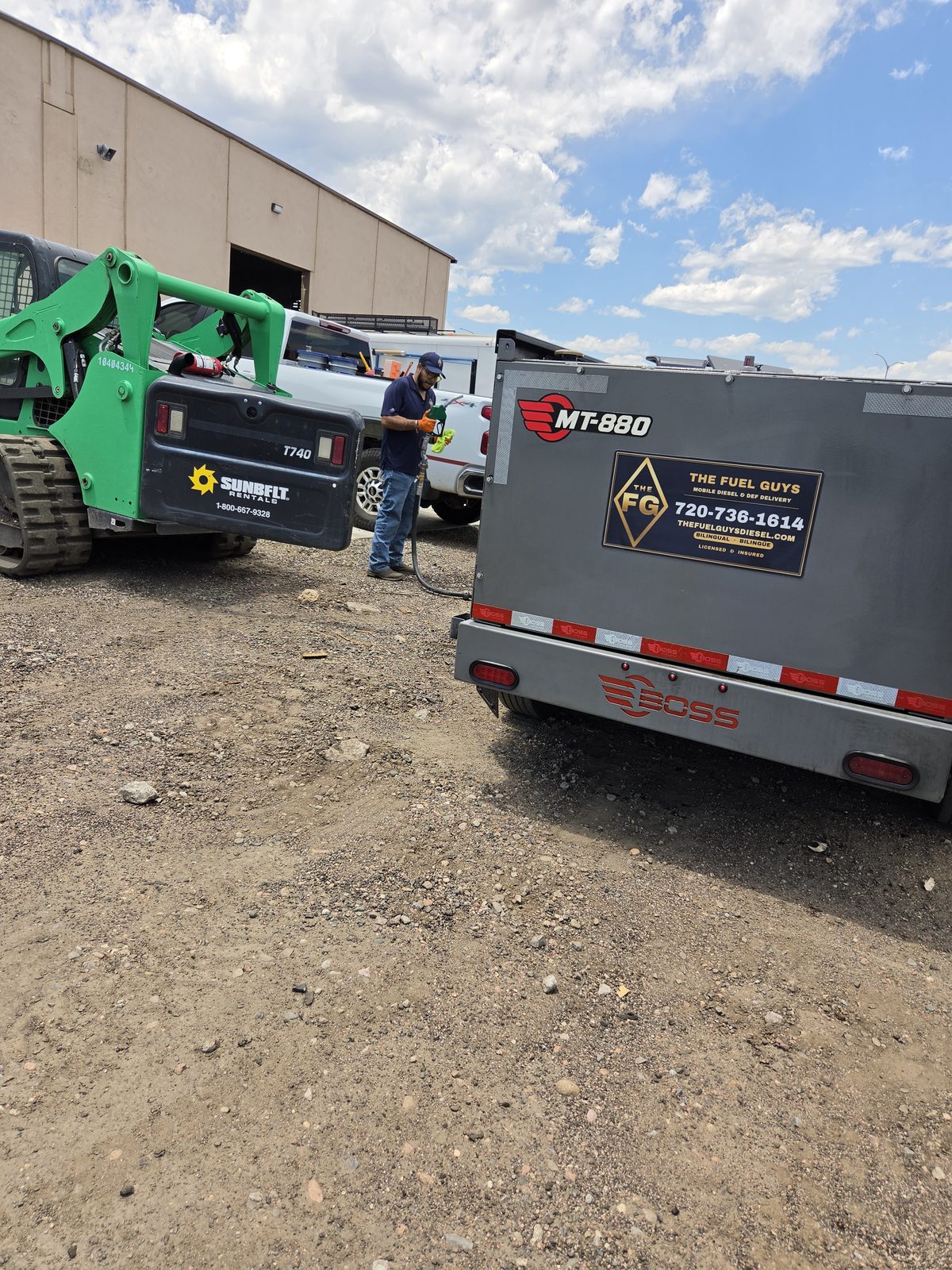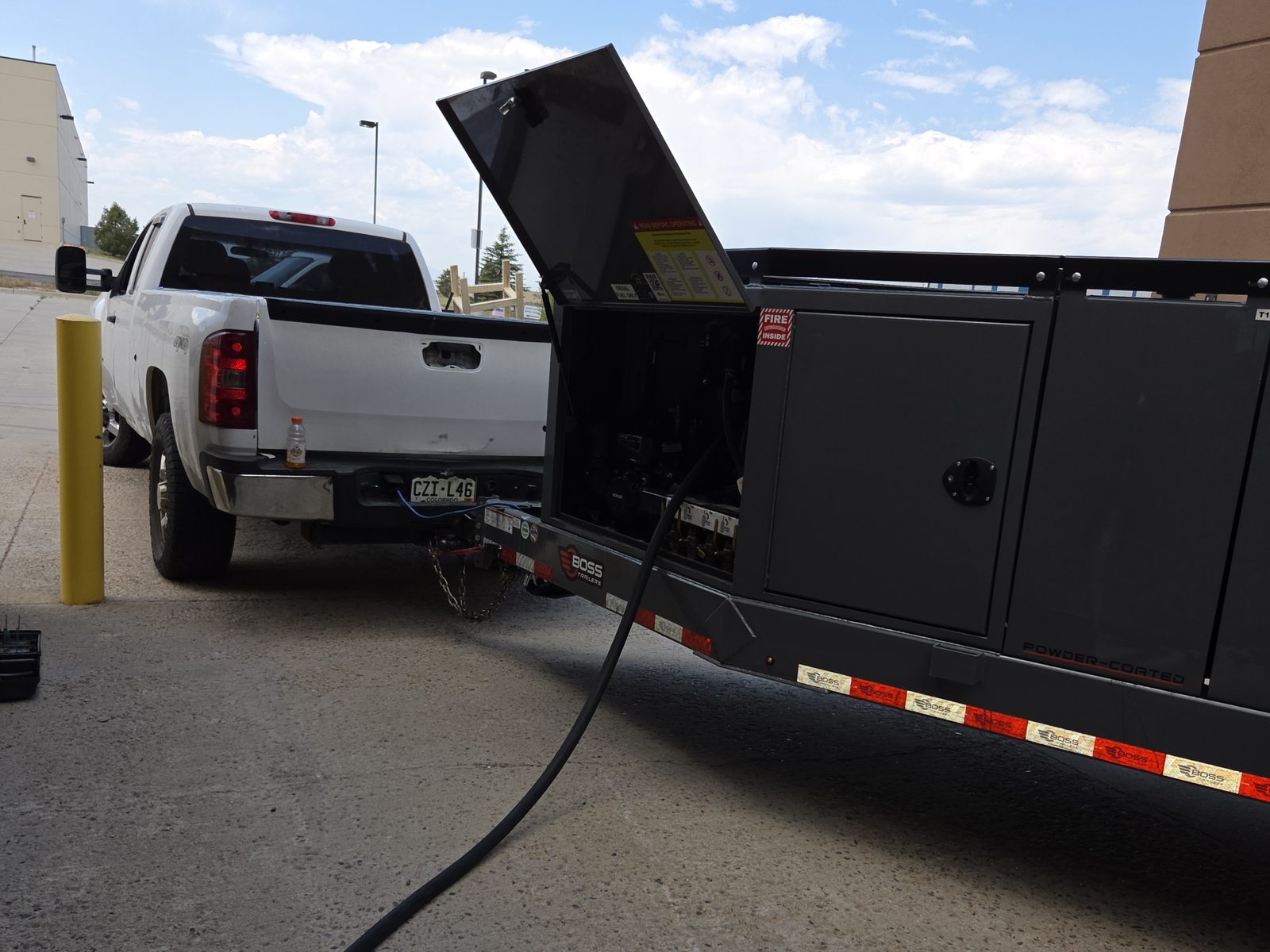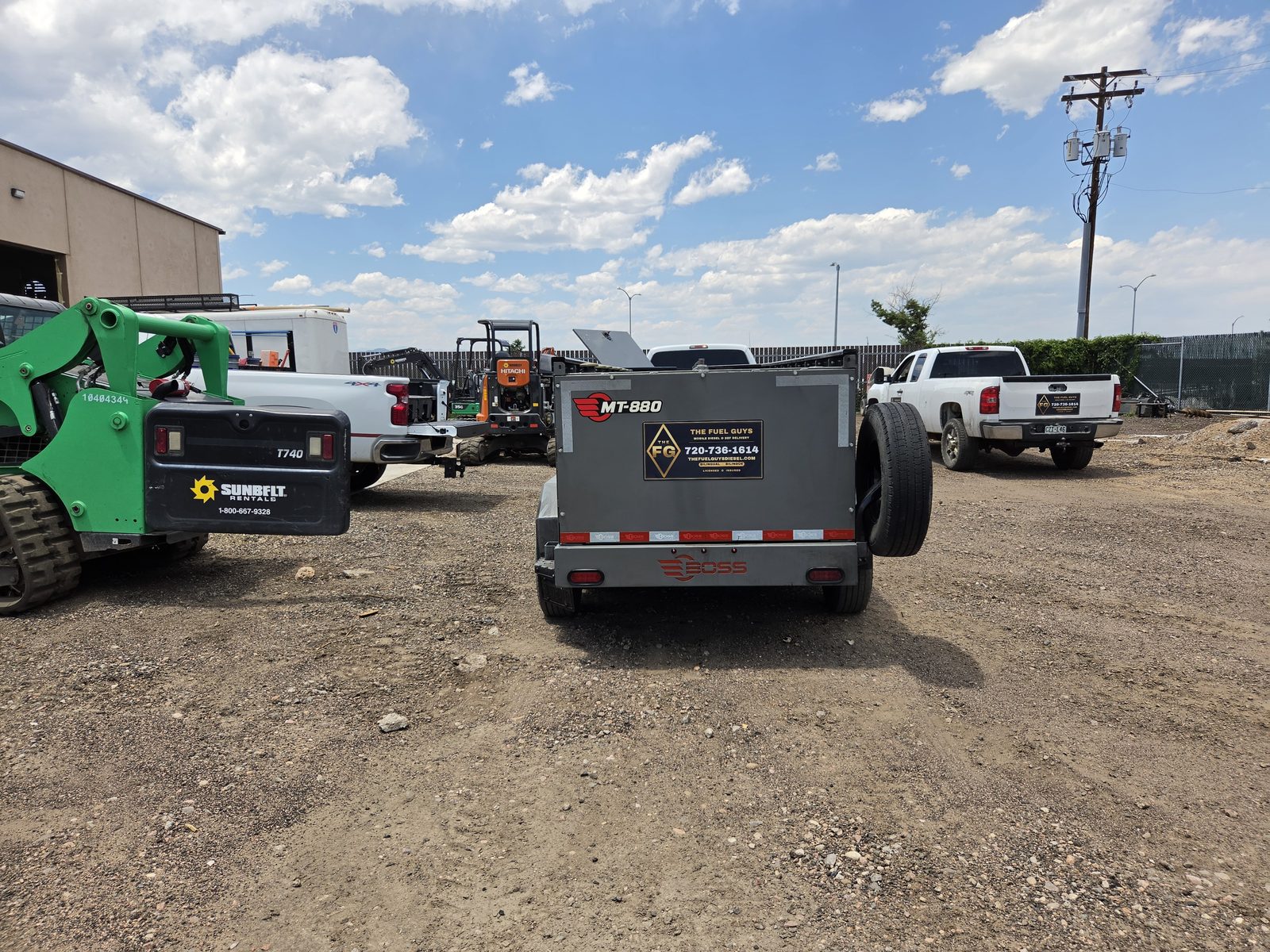
The rental yard will happily drop a 1,000-gallon tank on your site. It is the same haul for them either way. That is not the same thing as being the right size for your job.
The right quantity is the smallest one that keeps your machines running between fills. Every gallon past that point buys you paperwork, exposure, and working capital sitting in a steel box on a gravel lot. Here is how we size it, and the numbers that should cap the answer.
What is the formula for sizing a job-site fuel tank?
Three inputs, one line of arithmetic:
Tank size = (daily burn × days between deliveries) + one day of reserve
The reserve is not padding. It is the day a delivery slips, the Saturday the crew works to make up weather, or the morning a second machine shows up unannounced. One day is usually enough. Two is a tank that is too big for most sites.
Then round the result down toward the nearest regulatory threshold rather than up to the next tank size. A 500-gallon tank filled weekly is a cheaper, quieter piece of equipment than a 1,000-gallon filled every other week, even though both move the same fuel across the month.
How much diesel does job-site equipment actually burn?
Do not guess. Caterpillar publishes hourly fuel consumption by model in the Caterpillar Performance Handbook, and every other major OEM publishes something equivalent. A sample from Edition 46, in U.S. gallons per hour:
| Machine | Low load (gal/hr) | Medium load (gal/hr) | High load (gal/hr) | Medium load, 8-hr day |
|---|---|---|---|---|
| 302.4D mini excavator | 0.31–0.47 | 0.47–0.62 | 0.62–0.78 | 4–5 gal |
| 311D RR excavator | 0.9–1.7 | 1.7–2.5 | 2.5–3.4 | 14–20 gal |
| 312D excavator (STD) | 1.1–2.0 | 2.0–3.0 | 3.0–4.0 | 16–24 gal |
| 320F excavator (STD) | 1.4–2.9 | 2.9–4.3 | 4.3–5.7 | 23–34 gal |
| 345D excavator | 4.1–8.1 | 8.1–12.0 | 12.0–16.1 | 65–96 gal |
The last column is the medium-load range multiplied by eight. It is arithmetic, not a separate claim.
Two caveats. Published figures describe a machine that is working; a site with a lot of idle will land lower per hour but often runs more hours. And if you have three months of your own hour meters and fuel tickets, use those instead. Your own numbers beat anybody's table, including ours.
A worked example from an ordinary Denver site — a 320-class excavator, a 312-class, and a mini, all at medium load for an eight-hour day — comes to roughly 43 to 63 gallons a day. Call it 55. On a weekly fill that is 5 × 55 = 275 gallons, plus a 55-gallon reserve, or 330. That site wants a 500-gallon tank, not a 1,000.
What quantity thresholds should cap the number?
These are the quantities that change what you owe the moment you cross them. This is the part contractors usually discover after the tank is already on site.
| Quantity | What changes | Authority |
|---|---|---|
| More than 60 gallons outdoors | Operational permit required for Class II or Class IIIA liquids stored, handled or used outside a building | Denver Fire Code § 105.5.32(3) |
| Any single container over 60 gallons | Stops being a “container” under OSHA; the portable-tank provisions apply instead | 29 CFR 1926.152(c)(1) |
| 660 gallons or more in one tank | Colorado’s aboveground storage tank regulations begin to apply | 7 CCR 1101-14, § 3-1 |
| 1,100 gallons in one pile or area | OSHA ceiling for a group of containers of 60 gallons or less | 29 CFR 1926.152(c)(1) |
| 1,320 gallons aggregate | Written SPCC plan, secondary containment, inspections, trained personnel | 40 CFR 112 |
The 660-gallon line almost nobody in this trade knows about
Colorado’s storage tank regulations, administered by the Division of Oil and Public Safety, exclude any aboveground tank “whose capacity is greater than 39,999 gallons or less than 660 gallons.” A 500-gallon skid tank sits below that floor. A 1,000-gallon tank does not.
There is a construction carve-out, and it is discretionary rather than automatic. The rules exclude tanks storing flammable and combustible liquids “at mining facilities and construction and earthmoving projects … where, in the opinion of the Director, tight control by the owner or contractor and isolation from other structures make it unnecessary to meet the requirements of this article.” That is a judgment call by a state official, not a box you check. Staying under 660 gallons per tank removes the question entirely.
The 1,100-gallon number is narrower than people think
OSHA’s 1,100-gallon limit applies to a pile or group of containers of not more than 60 gallons each. In a June 2000 interpretation letter about a 1,000-gallon diesel tank on a construction site, OSHA said plainly that 1926.152(c)(1) and (c)(3) do not reach a tank that size — the outdoor portable-tank provisions at (c)(4), (c)(5) and (c)(7) do instead. That does not make containment optional — your fire authority and your stormwater permit will almost certainly require it. It means OSHA is not the agency imposing it at that size.
What actually counts toward the EPA’s 1,320 gallons
SPCC counts aggregate aboveground capacity, not contents, and it counts containers of 55 gallons and larger. Three empty 500-gallon tanks are still 1,500 gallons of capacity. But EPA excludes “motive power containers” — the onboard tanks that fuel the machine’s own movement, explicitly including “diesel and hydraulic fluid tanks on construction equipment.” Your excavator’s own tank does not count against you. A fuel trailer or skid tank used for storage does.
The permit process, the setbacks, and the paperwork the fire authority asks for are covered in detail in do you need a permit to store diesel on a Denver job site. Thresholds vary across the metro — Denver Fire, Aurora, South Metro, West Metro, North Metro and the Adams County districts each amend the fire code on their own — so confirm the number with the authority having jurisdiction over your address before you order steel.
Why is a bigger tank not the safer choice?
Oversizing feels conservative. It usually is not.
- It parks your money. At the delivered off-road (dyed) range we published in July 2026, $3.09 to $4.09 a gallon, a 1,000-gallon tank kept full is roughly $3,100 to $4,100 of working capital parked on the site. See what mobile diesel delivery costs in Denver for how that price is built.
- It slows your fuel turnover. EPA’s Office of Underground Storage Tanks calls monitoring for water and keeping it to a minimum “standard industry practice and part of a critical regular maintenance routine.” A tank that turns over weekly is easier to keep clean than one that turns over monthly.
- It adds administrative weight you cannot delegate. Crossing 1,320 gallons means a written plan, containment sized for the largest container plus precipitation, inspection records, and trained personnel — for the life of the job.
- It has to move. Tanks get relocated as the site progresses. A 500-gallon skid moves with a telehandler. A full 1,000 does not move until somebody drains it.
- It advertises itself. A large tank sitting unattended over a long weekend is a known target.
What if the right answer is zero gallons on site?
For a lot of Denver-metro jobs, it is. If a fuel truck comes to the site on a schedule and fills each machine from the hose, there is no bulk storage container to permit, contain, placard, inspect, or defend. No SPCC threshold to track. Nothing sitting there over a three-day weekend.
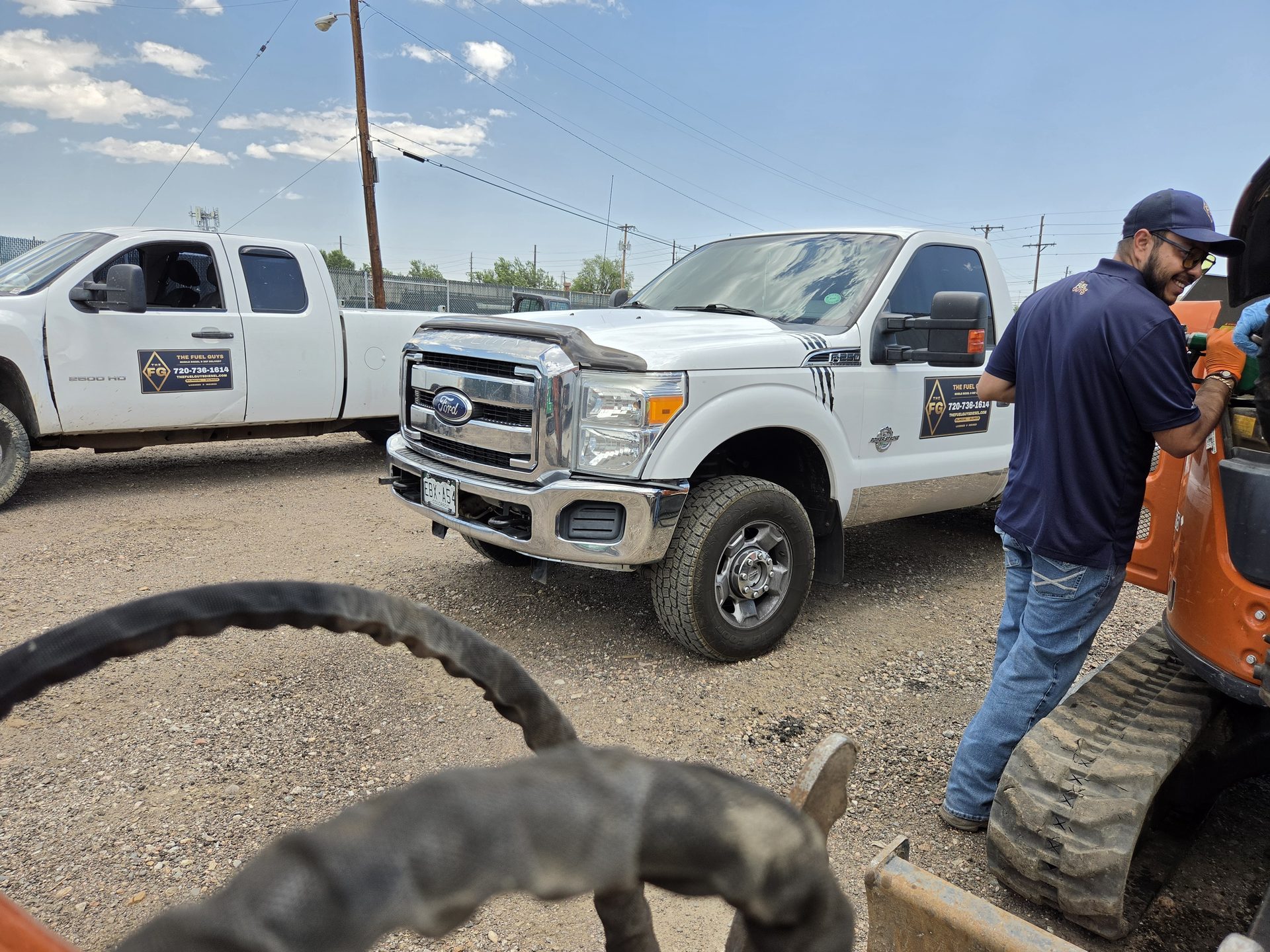
One detail worth knowing: in Denver, the operational permit for on-demand mobile fueling attaches to the fueling operation under § 105.5.32(10), and the fire code official may separately require a permit for the site where it happens under § 105.5.32(11). Ask your fuel supplier which permits they hold before you assume the obligation is theirs. We walk through the full trade-off in wet hosing versus a job-site tank.
So what do we tell Denver contractors to keep on hand?
This is our practice, not a code requirement. Run your own numbers against it. A weekly fill has to cover five working days plus the reserve, so the tank works out to about six times the daily burn. Twice a week the longest gap is three working days, so it is about four times.
| Site burn | What we usually recommend | Why |
|---|---|---|
| Under 30 gal/day | No tank. Scheduled direct-to-equipment fueling. | The permit, containment, and crew time cost more than the tank saves. |
| 30–80 gal/day | 250 to 500 gallons, filled weekly. | 6 × 80 = 480 gallons. Fits a 500 with the reserve intact. |
| 80–125 gal/day | 500 gallons, filled twice a week. | 4 × 125 = 500. Still below the 660-gallon Colorado line. |
| 125–160 gal/day | The largest tank that still stays under 660 gallons, filled twice a week. | 4 × 160 = 640. The last band that clears every threshold above 60. |
| Over 160 gal/day | Add delivery frequency before you add capacity. | Past this point you are choosing between more trips and an SPCC plan. Decide in week one, not month three. |
The pattern underneath every row is the same: the delivery schedule sets the tank size, not the other way around. A supplier who reliably shows up twice a week lets you run a smaller tank, and a smaller tank is cheaper on every axis that matters.
We deliver diesel and DEF across the Denver metro and Front Range, on scheduled routes and on call. If you want help running these numbers for a specific site, request a quote or set up a delivery schedule and tell us what is on the ground — machine list, hours, and how long the job runs. That is enough to size it properly.